About Smart Continents’21
Smart Continents’21 invites all scientists in the World involved in complex systems studies to build the first ‘living’ Roadmaps of the scientific and societal challenges at all territorial scales. In 2021, a special emphasis between Universities and the planet is continents. But the beauty of this roadmap process is to cover all the territorial scales from their Universities or Research centers to the Planet. Such a living Roadmap is a “smart scientific and social process” combining the “smartness” of scientific and societal challenges. “Smartness” of a scientific challenge means international transdisciplinary interactions toward the best possible experimental and theoretical studies on Complex Systems. “Smartness” of a societal challenge means involving the most urgent continental challenges inside the 17 UN Objectives of Sustainable Development for 2030.
The 17 UN SDGs and
their 169 targets for 2030

-
Great Questions about Complex Systems
Crossing great questions with great domains
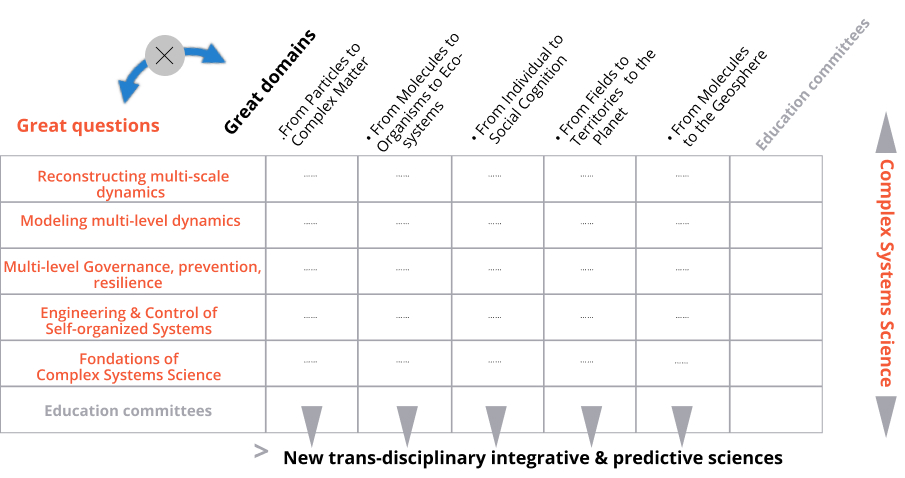
Conceptual Roadmap of complex systems
Smart Continents’21 is organized by the Complex Systems Digital Campus (CS-DC.org), a UNESCO UniTwin. A UniTwin (University Twinning) is a network of Universities launching a new science, here addressing the transdisciplinary challenges on complex systems. There are two complementary ways to build the CS roadmap for these transdisciplinary challenges:
The first considers the great theoretical questions which cut across the experimental classes of complex systems and, the second takes the perspective of the experimental great classes as they cut across the theoretical great questions. In other words the theoretical questions cut across scientific domains such as psychology, economics, chemistry and medicine, while each domain must address all of the theoretical questions.
Great Domains of Complex Systems
SIRE: Socially Intelligent Roadmap Ecosystem
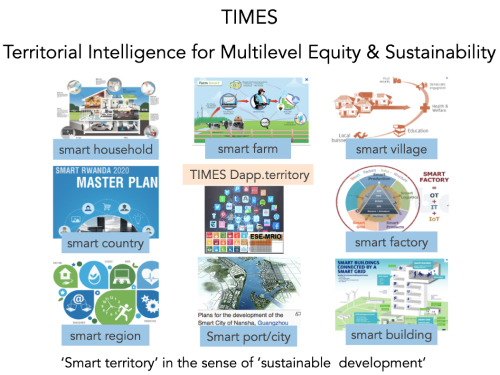
The beauty of such CS roadmaps is that these two ways are creating the above matrix crossing great questions and great classes. The scientific “smartness” of the matrix is to create new scientific communities as transdisciplines, horizontally Complex Systems Science and, vertically, the new integrative and predictive sciences of the great classes: complex matter science, integrative biology and ecology, integrative cognitive science and environmental-social-economy of territories from households & farms to the planet can thus be immediately linked to the the “smartest” responsible innovations respecting the 17 UN Objectives of Sustainable Development for 2030.
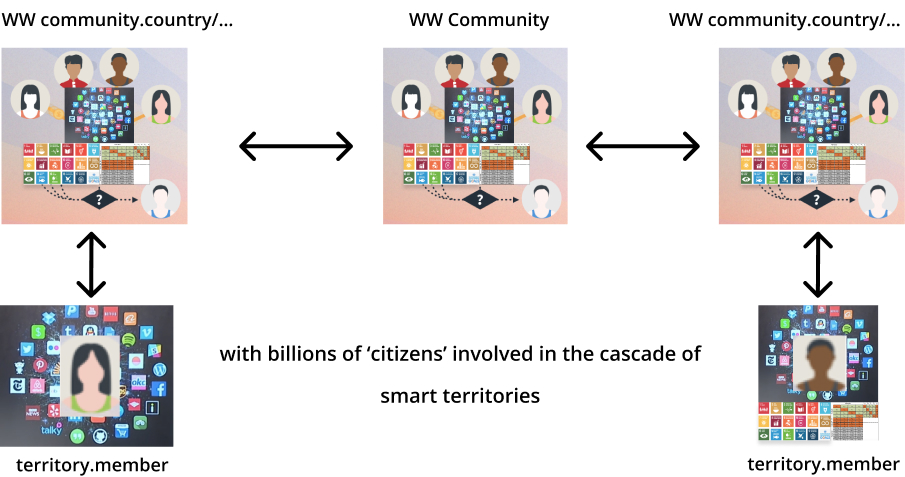
Worldwide Wellbeing
Community as a SIRE
Flagship Projects